
When a fire breaks out, every second counts. The difference between a swift, orderly evacuation and a chaotic scramble often comes down to one deceptively simple element: fire evacuation signs. Far from being mere decorative fixtures on a wall, these signs form the backbone of any serious emergency evacuation plan, guiding occupants to safety when visibility is poor, panic sets in, and familiar surroundings suddenly feel treacherous.
The essentials
- Fire evacuation signs are essential for guiding occupants to safety by providing clear, reliable direction during emergencies when visibility is limited and panic occurs.
- The system uses a standardized visual language of colors and symbols, such as green for exits, red for fire equipment, and blue for mandatory actions, to ensure intuitive navigation.
- Photoluminescent and internally lit signs are critical for maintaining visibility during power failures, ensuring escape routes remain identifiable in darkness.
- Signs must be strategically placed at all decision points, including corridor junctions and stairwells, to prevent uncertainty and minimize bottlenecks during an evacuation.
- Effective signage requires professional placement based on fire risk assessments to ensure signs are never obstructed, faded, or hidden from view.
- Legal compliance necessitates regular inspections and updates to signage to account for building modifications and ensure all safety equipment remains functional and legible.
How do fire evacuation signs guide safe escape during emergencies?
Understanding the role of fire safety signage begins with appreciating the conditions people face during a real fire incident. Smoke rapidly obscures vision, power supplies may fail, and visitors or new members of staff are unlikely to know the layout of a building instinctively. In that environment, well-designed signs cut through the confusion and provide immediate, reliable direction. Effective fire safety standards demand that signage delivers clear information at a glance, using distinct colours and universally recognised symbols so that anyone, regardless of language or familiarity with the premises, can act without hesitation.

Recognising the visual language of evacuation signage
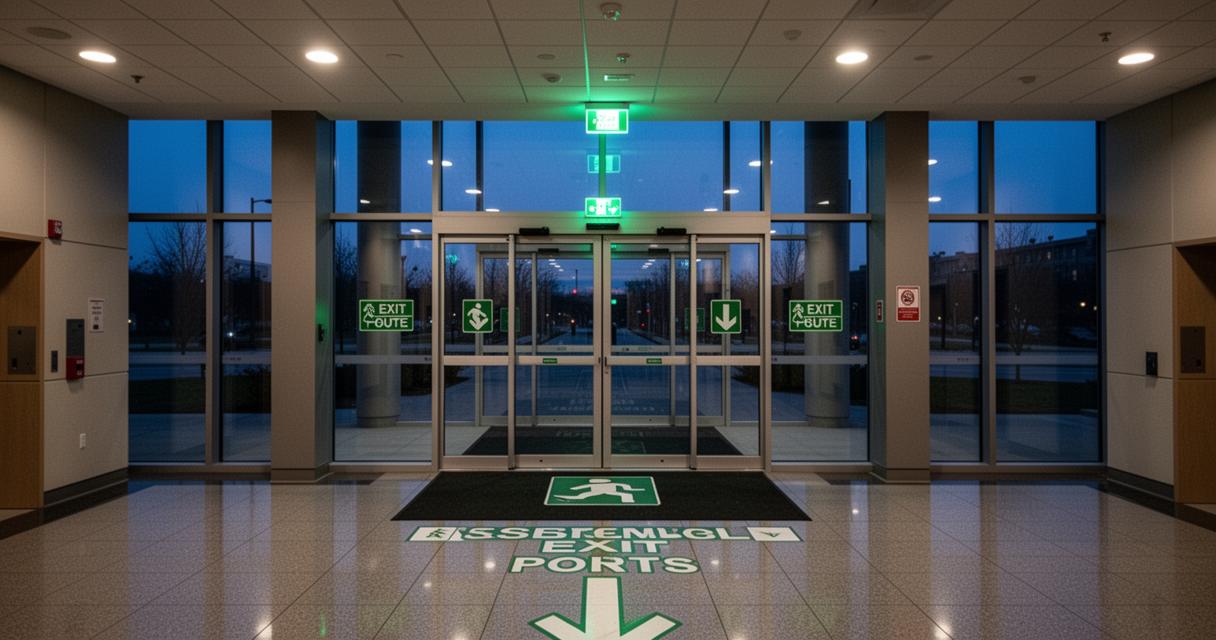
The visual grammar of exit signage has been carefully developed to be instantly readable under stress. Green signs with white pictograms mark fire exit routes, always paired with directional arrows so occupants know precisely which way to turn. Red signs identify firefighting equipment, helping people locate extinguishers and alarm call points swiftly. Mandatory action signs, typically blue, convey instructions such as keeping a fire door shut, whilst prohibition signs in red and white discourage dangerous behaviours like smoking in restricted areas. Together, this colour-coded system creates an intuitive map that works even when rational thought is difficult. Many modern installations also use photoluminescent signs, which absorb ambient light and continue glowing during a power failure, maintaining visibility without any electrical supply.
Creating clear escape routes under pressure
Signage alone is only effective when it forms part of a coherent evacuation strategy. Signs must be positioned at every decision point along an escape route — at corridor junctions, stairwells, and exit doorways — so that occupants never face a moment of uncertainty about which direction to take. Fire door signs play a particularly important role here, reminding people to keep self-closing doors shut and thereby slowing the spread of fire and smoke. When signage is well coordinated, it reduces bottlenecks, improves evacuation speed, and supports the kind of calm, purposeful movement that protects lives.
Why proper placement and maintenance matter for effective evacuation

Even the finest signs in the world are useless if they are obscured, damaged, or sited in the wrong location. Building safety professionals consistently emphasise that placement decisions should be informed by a thorough fire risk assessment, which takes into account the specific layout, occupancy, and hazards of each premises. A sign hidden behind a storage rack or faded beyond legibility is worse than no sign at all, because it creates a false sense of security without delivering any genuine guidance.
Positioning signs for maximum visibility in smoke and darkness
Emergency lighting systems and signage work hand in hand to keep escape routes visible when conditions deteriorate. Lit exit signs and green directional arrows powered by backup batteries or independent energy sources ensure that even a total power failure does not plunge an escape route into darkness. These systems also assist firefighters navigating the building, adding another layer of value beyond occupant safety. Signs should be mounted at a height where they remain visible above any accumulating smoke layer, and free of obstructions at all times. Clear signage at low level can also be invaluable, since people in a smoky environment instinctively drop closer to the floor.
Regular inspections to ensure signage remains functional
Maintaining fire safety compliance requires more than a one-off installation. Under legislation such as the Regulatory Reform (Fire Safety) Order 2005 and the Health and Safety (Safety Signs and Signals) Regulations 1996, businesses in the UK have clear obligations to keep their signage effective and up to date. Routine inspections should check for physical damage, fading, obstructions, and whether the signage still reflects the current layout of the building. As premises change — through refurbishment, changes in use, or shifts in occupancy — signage must be reviewed and updated accordingly. Regular training sessions for building occupants complement this maintenance effort, ensuring that everyone understands the meaning of each sign before an emergency arises. Investing in well-maintained fire equipment signs and fire protection measures is, ultimately, one of the most straightforward steps any organisation can take to safeguard the people within its walls.